Missed calls are lost jobs. Answering service, text-back or AI receptionist?
Answering service, missed-call text-back or AI receptionist: what each costs, who it suits, and the website fix that catches calls you can't answer.
Read the guide →
The fastest way to get more calls from your website usually isn't more visitors. It's fixing what people see in the first few seconds on their phone. To find out how common the problems are, we opened 440 websites of Big Island service businesses, from electricians and plumbers to dentists, law firms and fishing charters, on an iPhone-size screen. Half didn't show a phone number anywhere on the first screen. More than half offered no way to reach the business except calling.
By Elijah Ching · Published Nov 1, 2026 · 10 min read · Sites checked Nov 1, 2026
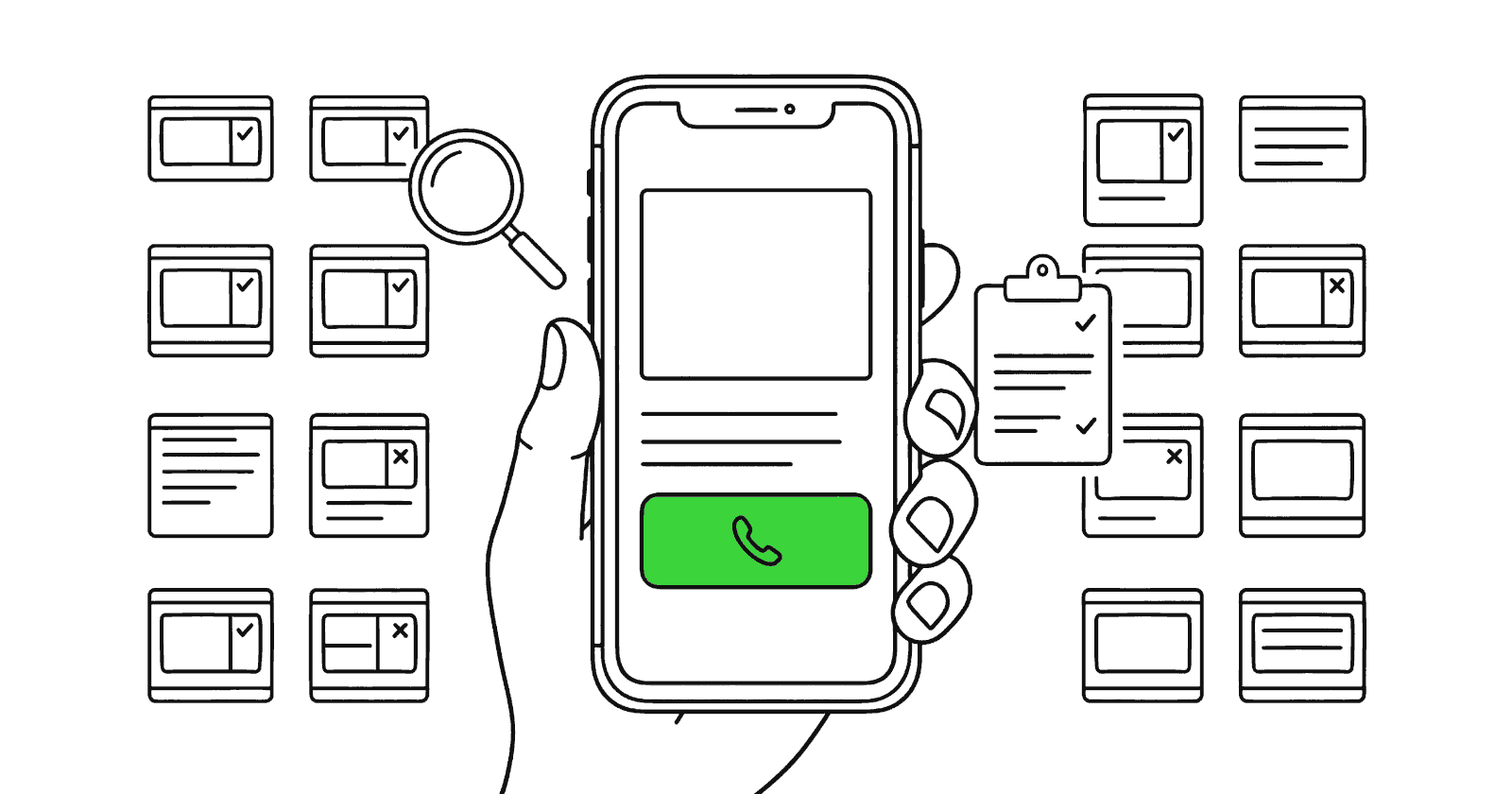
What we found on 382 working websites
We started with 690 service businesses listed on Google Maps around Hilo and Kona: trades and home services, dental and medical offices, law firms, charters, event businesses and a few shops. 230 of them, a third, list no website at all. The rest listed 440 different websites.
On November 1, 2026, a script opened each homepage in Chrome at the size of an iPhone screen, 390 by 844 pixels, and recorded what a visitor sees before scrolling: whether a phone number shows, whether it's a tap-to-call link, and which buttons appear. It also checked the whole homepage for forms, online booking, chat, text links, reviews, prices and links to social media. 382 homepages loaded normally. We checked 12 of them at random against screenshots, and the script matched what a person sees on all 12.
Three limits worth knowing. We only looked at homepages, so a business with a form on its contact page counts as having no form here. A script reads words, so a reviews section that never uses the words "review," "testimonial" or a star rating won't count. And these are Big Island businesses, but they use the same website builders and templates as everyone else. We don't name any business.
191 of the 382 homepages, 50%, showed no phone number before scrolling. Only 40% had a tap-to-call link there. The number was usually somewhere: two thirds of the sites had a tap-to-call link further down the page or in a menu. It just wasn't where a customer looks first.
The worst case is the emergency call. 66 sites advertise emergency or 24/7 service, and 23 of them, 35%, don't show a number on the first screen. Someone with water on the floor shouldn't have to scroll.
Phone number on the first screen, by website builder
The builder makes a big difference, because the template decides what the phone version of your site looks like, and most owners never check it.
The fix: put your number at the top of every page as a tap-to-call link, the kind written as tel:+18085551234, and keep a call button on screen as people scroll. Safari on iPhone often turns a typed phone number into a link by itself, but you shouldn't count on every phone doing that. Then open your site on your own phone and tap it.
206 homepages, 54%, offered no other way to get in touch: no form, no booking, no chat and no text option. Only 16 sites, 4%, offered a way to text. 26 offered online booking, and half of those were fishing charters using FareHarbor. Seven had a chat window.
That matters because the person who answers the phone is usually working. On Reddit's small business forums, owners ask the same question again and again: how do you stop missing calls when you're on a job? The answer they hear from other owners: callers who reach voicemail often try the next business instead. And speed counts. In a Harvard Business Review study of 2,241 US companies, those that tried to contact a web lead within an hour were nearly seven times as likely to reach a decision maker for a real conversation as those that tried even an hour later, and more than 60 times as likely as those that waited a day or longer.
Customers notice, too. Among the businesses in our list whose most recent Google review was one or two stars, 6 of 62 were about calls or messages nobody returned, not about the work itself.
The fix: give people a second way in that works while you're busy. A "Text us" button, a short form that goes straight to your phone, or online booking if your work fits into time slots. Then say when you'll reply, such as "We text back within two hours, 7 am to 6 pm." For the phone side, see answering service, text-back or AI receptionist.
190 businesses on our list are rated 4.5 stars or higher with at least 10 Google reviews. The typical one has 34 reviews. 78 of them, 41%, don't mention reviews, testimonials or a star rating anywhere on their homepage. Only 23% show reviews in a widget.
Their best sales tool is on Google, while the website, the place people go to decide, says nothing about it.
The fix: show your rating and number of reviews near the top, then three short, real reviews with the customer's first name and town, and a link to read them all on Google. Swap in new ones every few months.
144 homepages had a contact form. The typical one asks for 4 things, and 56% ask for 4 or fewer. But 15% ask for 7 or more before someone can send a message.
The fix: name, phone number, town and what you need is enough to call someone back. A photo upload helps trades quote faster, as long as it's optional. Below the button, say what happens next.
Even on our fast office connection, the typical homepage took 3 seconds to finish loading, and 17% took more than 5 seconds. 18% weighed over 3 MB, mostly from photos that were never shrunk for the web. On cell signal, all of it is slower.
The fix: resize and compress photos, drop the slider and the autoplay video at the top, and test your homepage in Google's free PageSpeed Insights.
57% of the homepages link to at least one social media profile: Facebook 47%, Instagram 37%, YouTube 13% and TikTok just 2%, seven sites. Among home service businesses, only two link to TikTok.
Social media rarely produces a phone call straight from a post. For a local business it does two other jobs: people see your work before they need you, and people who heard your name check you out before they call. Views alone don't pay. On Reddit, someone posting videos for a friend's tree service said 1.8 million views brought maybe one real lead. The replies pointed to the same fixes: show who does the work, say where you work, and reach people in your service area instead of everywhere.
The fix:
If you want help with the posting and the path back to your phone, see our social media marketing.
A third of the 690 businesses list no website on Google at all. Their typical Google profile has 2 reviews, compared with 13 for businesses with a website, and their average rating is 4.37 stars compared with 4.68. That doesn't prove a website earns reviews; established, busy businesses tend to have both. But a business with no website and two reviews gives a new customer very little to go on.
440 websites listed on Google profiles
Your Google profile is often the first place people find you. If its website link is dead, you lose the customer at the door, and nothing tells you it happened.
The fix: open your Google Business Profile on your phone today and tap your own website link. If your site isn't showing up on Google in the first place, start with why your website isn't showing up on Google.
Do this on your own phone, on cell data, not office Wi-Fi.
Every site we build launches with a tap-to-call number at the top, a second way to reach you and your reviews near every button. If your site is fine otherwise, our conversion optimization fixes these on the site you already have, and we track the calls and forms so you can see what changed. For the social side, see social media marketing. Plans start at $249 a month.
Checked November 1, 2026.
Put your phone number at the top of every page as a tap-to-call link, and add a second way to reach you, such as a text button or a short form. In our check of 382 local business websites, 50% showed no phone number on the first screen and 54% offered no way in except calling.
Yes, on every page, as a link that dials when tapped. Keep a call button visible as people scroll, too. Many visitors to a local service business's website are on a phone and ready to call.
Yes. Some customers can't talk when they find you, and you can't always answer. A short form or a text button catches both. Keep it to name, phone number, town and what they need, and say when you'll reply.
Show your star rating and number of reviews near the top of the homepage, add three short real reviews with first names and towns, and link to your Google profile to read them all. A review widget can update this automatically, but a few hand-picked reviews work too.
Indirectly. People see your work and look you up before calling. Make it easy: list your towns and phone number in your profiles, link to a page that starts with your number, and answer messages as fast as calls.
Count what it produces, not visits: calls from the website, form messages and texts each month. A tracking phone number on the site, the call and website clicks in your Google Business Profile, and asking every new customer how they found you will tell you most of it.
Answering service, missed-call text-back or AI receptionist: what each costs, who it suits, and the website fix that catches calls you can't answer.
Read the guide →Real price ranges for a redesign, when a cheaper refresh is enough, and the checklist that keeps your Google rankings when the new site goes live.
Read the guide →Tell us what you do and who you are trying to reach. We will send back a plan and a specific price. No cost, no obligation, and no pressure.